
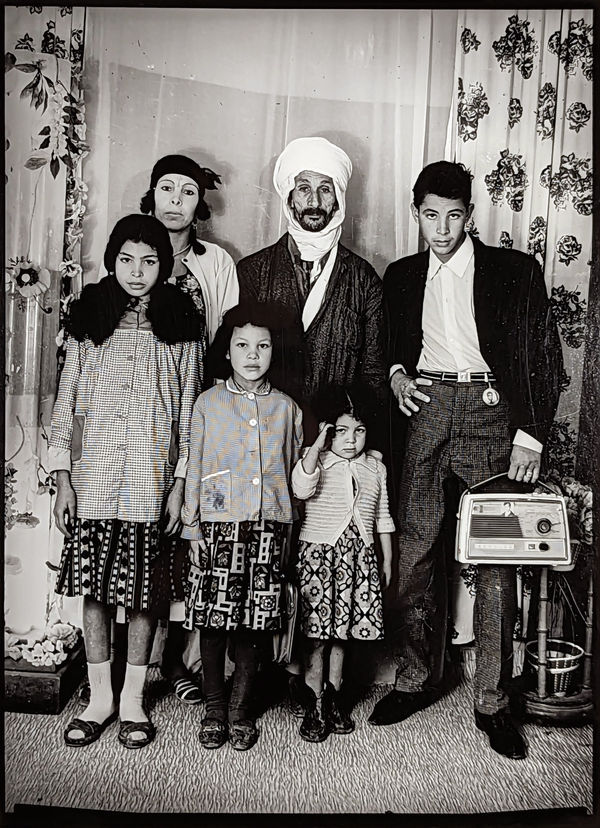
On loan from Westwood Gallery NYC, photographs of residents of Aïn Beïda, Algeria by Lazhar Mansouri are on view at the Tate Modern in A World in Common: Contemporary African Photography. The exhibition, curated by Osei Bonsu, curator of International Art at the Tate Modern, addresses how photography like Mansouri's, as well as other forms of media have been used to reimagine Africa’s diverse cultures and historical narratives.
Mansouri first encountered photography as a child while accompanying his grandmother to a local bazaar, where he met a photographer operating a studio in the back of a barber shop. The same photographer later hired him as an apprentice, allowing Mansouri an introduction to the craft. After his training, he left to open his own small studio in the back of a grocery store. Mansouri’s photo studio served thousands of Algerians with their photographic needs from id card photos to documenting family occasions. From the images reflected, Mansouri photographed weddings, births, children, graduations, portraits, friends, and family.
A World in Common
Tate Modern, London
6 July 2023 – 14 January 2024



Tate Modern:
A World in Common: Contemporary African Photography brings together 36 artists who use photography to reimagine Africa’s place in the world. It is inspired by the continent’s rich cultural traditions, as well as present-day social and political realities. Drawing on the theories of Cameroonian philosopher Achille Mbembe (born 1957), the exhibition invites us to imagine ‘a world in common’. To do this, Mbembe claims, we must ‘think the world from Africa’. A World in Common explores Africa’s past, present and future to create a more expansive and inclusive narrative of humanity. It suggests that to conceive ‘a world in common’ is to imagine a future of possibility.
There is no single, definitive history of Africa. It is a continent of multiple, interconnected realities. Pushing the boundaries of photography and film, the artists in A World in Common confront reductive representations of African peoples and cultures. They address photography’s past and embrace its potential to reframe the present and shape tomorrow.
The exhibition is divided into three chapters: Identity and Tradition, Counter Histories and Imagined Futures. The first chapter is rooted in ancient African cultures and traditions which have survived periods of struggle and resistance. Inspired by Pan-African liberation movements, the second chapter looks at photography’s ability to produce counter histories - archival practices and the agency of photographer and subject are brought into focus. The third chapter explores the impact of globalisation and the climate emergency. Here, artists imagine a shared future informed by common realities. A World in Common creates space for exchange and discovery, inviting us to imagine new ways of inhabiting the earth.


